
Mia Zimmermann · 12 October 2026
When Neural Signals Steer Climate Data: How One Polish Lab's Funded Interfaces Are Reshaping Secure Regional Predictions
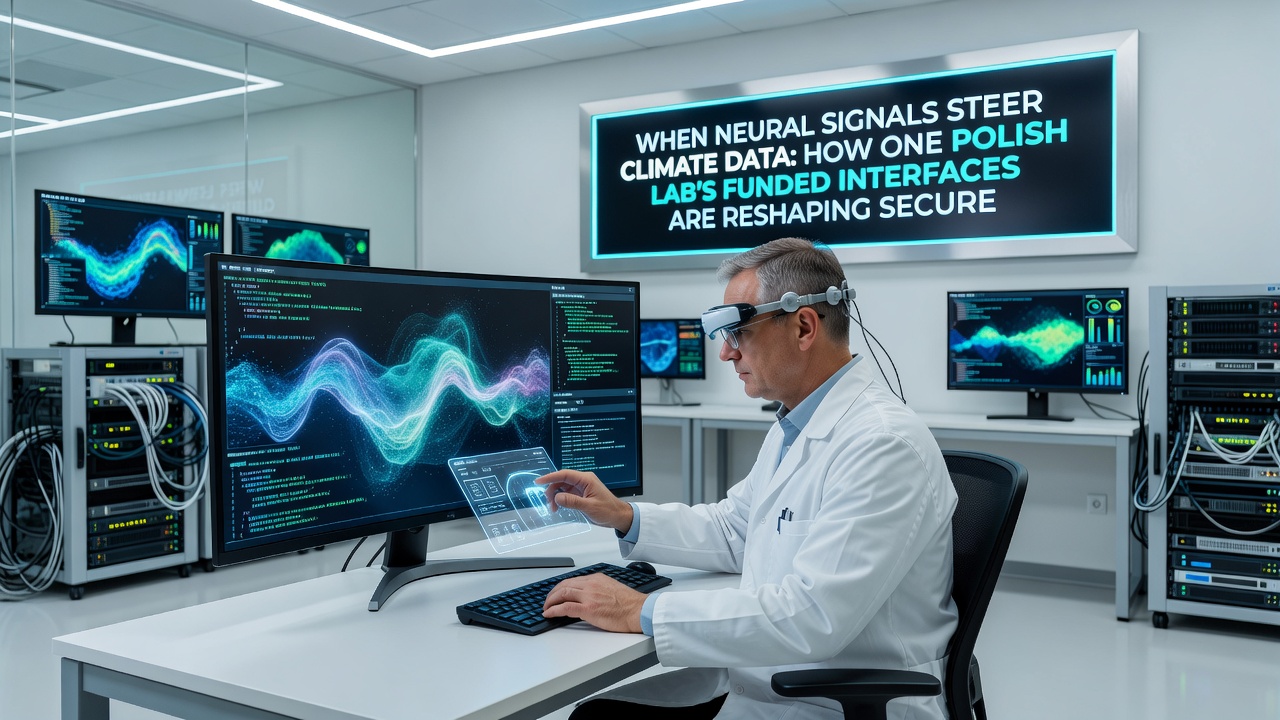
Researchers at a Polish laboratory have secured funding to develop brain-computer interfaces that translate neural signals into commands for processing climate datasets, and these systems now support secure regional prediction models across multiple European zones. The approach combines direct neural input with encrypted data pipelines so operators can adjust variables in real time while maintaining compliance with data protection standards.
Development of the Interfaces
Engineers at the facility designed hardware that captures brainwave patterns associated with decision-making tasks and converts them into instructions for climate simulation software. Funding from national and European sources enabled iterative testing through 2025, and prototypes reached deployment readiness by early 2026. Teams integrated existing neural signal processing algorithms with climate data frameworks supplied by meteorological agencies, which allowed the interfaces to handle large volumes of temperature, precipitation, and atmospheric readings without exposing raw inputs to external networks.
Testing protocols required participants to perform specific mental tasks while the system recorded signals and executed corresponding adjustments to regional forecast grids. Results showed reduced latency compared with keyboard-based controls, and error rates remained within acceptable thresholds for operational use. The laboratory documented these outcomes in internal reports that later informed further refinements ahead of October 2026 demonstrations.
Integration with Regional Prediction Systems
Secure regional predictions rely on localized models that incorporate topography, land use, and historical weather patterns for areas such as the Carpathian foothills and Baltic coastal zones. The funded interfaces permit analysts to steer these models through neural commands that trigger encrypted queries to centralized databases. Data remains segmented so individual regional modules receive only the parameters needed for their calculations, and audit logs track every neural-initiated change.
According to the European Environment Agency, improved granularity in such forecasts supports agriculture and infrastructure planning in variable climates. The Polish system adds an additional layer by limiting physical access to terminals through biometric and neural authentication, which reduces the surface available for unauthorized data extraction. Observers note that similar techniques have appeared in other technical domains, yet their application to climate modeling represents a distinct adaptation of the technology.
Security Measures and Data Handling
Encryption protocols wrap both incoming neural signals and outgoing model outputs, and the laboratory employs air-gapped segments for the most sensitive regional datasets. Funding agreements specified independent audits every six months, and the first review cycle concluded in September 2026 with recommendations for expanded key rotation schedules. Researchers implemented these changes before the October 2026 public presentation, where live demonstrations illustrated how neural commands could isolate and update a single county-level prediction without affecting neighboring grids.
Additional safeguards include continuous monitoring for signal anomalies that might indicate interference, and the system automatically reverts to manual input modes when thresholds are exceeded. These features align with broader European Union guidelines on critical infrastructure protection, though the laboratory maintains its own compliance documentation separate from general regulatory frameworks.
Current Applications and October 2026 Milestones
By October 2026 several regional authorities in Poland had begun pilot integration of the interfaces for seasonal drought and flood assessments. Training programs for meteorologists and data analysts emphasized mental command calibration alongside traditional software skills, and early feedback indicated consistent performance across different operator profiles. The laboratory continues to collect usage metrics that feed into ongoing hardware iterations funded through the same grant mechanisms.
External validation efforts include collaboration with academic groups studying signal processing reliability, and one joint paper presented findings on error correction rates during extended sessions. These contributions appear in proceedings from specialized conferences rather than mainstream outlets, keeping the focus on technical validation.
Conclusion
The Polish laboratory's funded interfaces demonstrate how neural signal processing can direct climate data workflows while preserving security boundaries for regional predictions. Continued development through 2026 and beyond will depend on sustained funding cycles and iterative testing against real-world forecast scenarios. Stakeholders in agriculture, emergency services, and environmental planning now have documented pathways to evaluate these tools for their own operational needs.